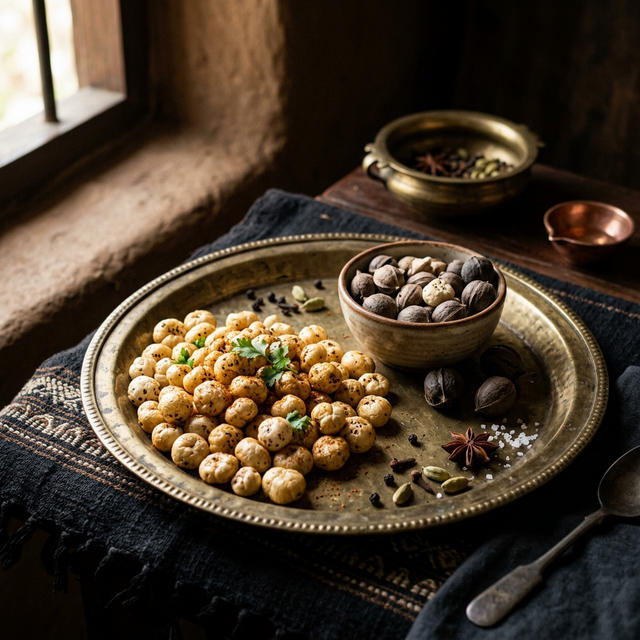
In the fast-paced, modern wellness industry, "superfoods" seem to appear out of nowhere. A new berry, grain, or seed goes viral on social media overnight, only to completely disappear from supermarket shelves a few months later. However, there is a fundamental difference between a fleeting nutritional trend and an enduring, time-tested superfood. While Western health circles and modern nutritionists are just now discovering the phenomenally dense nutritional power of the "fox nut," makhana is by no means a new discovery. The history of makhana is deeply woven into the fabric of ancient Asian civilizations, having been a revered staple in Indian culture, medicine, and spirituality for millennia. Let us take a journey back in time to explore the fascinating origins of this ancient superfood.
The Geographical Origins: The Ponds of Bihar
To trace the origin of fox nuts, we have to look to the shallow, stagnant wetlands and marshy ponds of Eastern Asia. While the Euryale ferox plant (from which makhana seeds are harvested) can be found in parts of China, Japan, and Russia, its true agricultural and cultural heartland is the state of Bihar in Northern India. The incredibly specific climate and water conditions of the Mithila region of Bihar proved to be the ultimate breeding ground for this prickly water lily. For over three thousand years, the indigenous communities of this region, particularly the Mallah community, have cultivated and harvested these seeds, passing down the extraordinarily difficult and delicate harvesting techniques from generation to generation.
The Food of the Gods: Makhana in Hindu Spirituality
In traditional Hindu culture, a food's physical purity is critically important, particularly when it comes to religious offerings and fasting. Makhana occupies a uniquely elevated status in Hindu traditions—it is widely considered to be one of the purest foods in existence. Because the seeds grow encapsulated within a pod, submerged in water, and are entirely untouched by insects or harsh environmental pollutants before being harvested, they are deemed exceptionally spiritually pure.
During major religious festivals—such as Navratri, Diwali, and Makar Sankranti—makhana is famously offered to deities as "prasad" (a sacred, religious food offering). More pragmatically, makhana became the ultimate fasting food (Vrat meal). During strict religious fasts where grains like wheat and rice are strictly forbidden, ancient superfood makhana is utilized because of its incredibly dense, slow-releasing energy. A single bowl of fox nuts provides enough sustained carbohydrates and complex proteins to keep a fasting individual energized, focused, and physically strong throughout the day without violating complex religious dietary laws.
A Pillar of Traditional Ayurvedic Medicine
Long before modern laboratories were able to analyze makhana's precise macronutrient composition, ancient Ayurvedic healers completely understood its profound medical benefits. The history of makhana in traditional medicine is extensive. In ancient Ayurvedic texts, fox nuts are classified as heavily astringent and cooling.
Practitioners frequently praised makhana for its ability to balance the Vata and Pitta doshas. It was historically prescribed as a powerful restorative tonic for individuals recovering from severe illness. Ancient healers utilized it to build physical strength, improve reproductive vitality, and fundamentally promote overall longevity. Modern medical science has recently caught up to these ancient claims, confirming that the exceptionally high levels of antioxidants (like Kaempferol) and anti-inflammatory compounds found in makhana do, in fact, drastically reduce oxidative stress and combat cellular aging.
The Modern Resurgence
For centuries, the global perception of makhana was largely limited to its role in Indian religious fasting and traditional medicine. However, as the global demand for plant-based, gluten-free, and allergen-friendly nutritional options exploded in the 21st century, makhana naturally took the spotlight. It was the perfect, natural solution to the modern snacking crisis—a low-calorie, high-protein crunch that easily rivaled highly processed chips.
Conclusion
Today, enjoying a bag of Uncle Makhana's Classic Salted or Cream & Onion fox nuts provides much more than just a healthy, satisfying crunch. It connects you directly to a phenomenal, sacred history. What was once a localized crop isolated to ancient healing tonics and religious altars in Bihar has evolved into a globally recognized benchmark for healthy snacking. The history of makhana proves that true superfoods don't fade away—they endure across millennia.